
Showing posts with label EPA. Show all posts
Showing posts with label EPA. Show all posts
Thursday, September 4, 2014
Plug In Sports Cars Rated by the EPA
No long ago a hyper car's EPA fuel economy was nothing more than a specs footnote. These days however the owner and fan bragging rights might extend beyond acceleration and lap times and into EPA ratings. Earlier this year the Porsche 918 Spyder became the first plug in hyper car to be rated by the EPA to the tune of 20 mpg city and 24 mpg on the highway along with a gasoline equivalent of 67 mpg while operating solely on electricity. No longer is the 918 Spyder the only (almost) million dollar member of the plug in hybrid club as the McLaren P1 is now also officially rated by the EPA. The P1 is good for 16 mpg city and 20 highway and 17 in combined driving. It appears that while you can get up to 19 miles of plug in assisted driving from the battery, the benefits are so tiny that you will end up averaging only 1 mpg better driving as a plug in. For reference the McLaren 650S that uses a lower output version of the same 3.8 twin turbo V8 is good for 16 city and 22 highway, but of course the P1 blows it away performance wise. Thus the P1 does pretty well for greatly increasing performance while minimizing fuel economy loses. More impressive mpg wise, is the BMW i8 which is officially good for 28 mpg in the city and 29 on the highway as a hybrid and will deliver a combined gasoline and electricity usage rate of 76 mpg as a plug in in its first 15 miles. Of course the i8 is playing in the minor leagues performance wise compared to the 918 and the P1 but it's fun to compare regardless. It's unknown yet how well the last plug in hyper car, the Ferrari LaFerrari will do, but Ferrari has been able to harness the efficiency of the turbo to achieve an EPA rating of 16/23 for the California T. It's a decent improvement over the 14/19 rating of the original California.

Monday, March 19, 2012
Rumor: EPA Adjusts 328i's Impressive Fuel Economy Ratings
As the old adage goes, if something is too good to be true it probably is. When BMW announced the new F30 328i with the 2.0 liter turbo four cylinder it announced a new powerplant with 240 horsepower and a competition beating 24 city and 36 highway fuel economy rating when paired with the 8 speed auto. This made the new 3 series a sports sedan with the fuel economy of a compact. However, the folks at Bimmerfest are reporting that the EPA has/will adjust the 328i auto ratings to a more believable 23 city and 33 highway. Numbers that are still very good but not nearly as magical. While EPA's official fueleconomy.com is still reporting the old figures, BMW's own website says that the 328i auto will only achieve 23/33 mpg.
So the million dollar question becomes, how did this fuel economy fiasco occur? While the EPA ratings appear government official, the reality is that the agency only independently verifies only about 15% of all of the ratings that it publishes. Testing every single model on sale would certainly run up the tax payer bill. The manufacturers submit the ratings according to their own testing (using the EPA protocol) and then the agency audits some of the ratings to keep everyone honest. It appears the 328i automatic got audited and there was a discrepancy.

So the million dollar question becomes, how did this fuel economy fiasco occur? While the EPA ratings appear government official, the reality is that the agency only independently verifies only about 15% of all of the ratings that it publishes. Testing every single model on sale would certainly run up the tax payer bill. The manufacturers submit the ratings according to their own testing (using the EPA protocol) and then the agency audits some of the ratings to keep everyone honest. It appears the 328i automatic got audited and there was a discrepancy.

Thursday, May 26, 2011
Audi Engine Downsizing and New EPA Fuel Economy Ratings
Engine downsizing has been an industry buzzword for the past few years. The idea behind downsizing is to replace a large naturally aspirated engine with a smaller turbocharged or supercharged engine. At first this concept only applied to mainstream cars but has recently appeared on luxury brands as well. Even Mercedes AMG models are replacing their 6.3 liter naturally aspirated V8s with slightly smaller 5.5 liter twin-turbo V8s. Audi has gone one further with its all new 2012 A6 as the previous V6 model has been replaced with a four cylinder turbo and the V8 option has been dropped in favor of a supercharged V6. These downsized engines have delivered for Audi. Paired with a CVT transmission the A6 2.0T delivers 25 city and 33 highway for 28 combined, numbers rarely seen in the luxury category. The quattro 3.0 TFSI does quite well as well rated at 19 city and 28 highway.
Here are some other notable new ratings. City/highway (combined)
Aston Martin Rapide: 13/19 (15)
Audi A8 W12: 14/21 (16)
Lamborghini Aventador Coupe: 11/17 (13)
Lamborghini Avenador Roadster: 11/17 (13)
Lexus LFA: 11/16 (12)
Volkswagen Passat TDI: 31/43 (35)

Here are some other notable new ratings. City/highway (combined)
Aston Martin Rapide: 13/19 (15)
Audi A8 W12: 14/21 (16)
Lamborghini Aventador Coupe: 11/17 (13)
Lamborghini Avenador Roadster: 11/17 (13)
Lexus LFA: 11/16 (12)
Volkswagen Passat TDI: 31/43 (35)

Wednesday, November 24, 2010
Volt Gets Its EPA Sticker Also
Hot on the heels of the EPA announcement that the Nissan Leaf will get 99 MPGe, the Chevrolet Volt received its own EPA sticker today. Unlike the all electric Leaf, the Volt is a plug in hybrid and thus has three distinct fuel economy figures. On a full battery charge the Volt will travel about 35 miles while getting 93 MPGe, or only slightly worse than the Leaf. After the initial battery charge runs out the Volt consumes gasoline like a regular car. The EPA rates the Volt at 35 city and 40 highway when running purely on gasoline, these numbers place it slightly above compact cars fuel economy wise. Overall, the EPA predicts that through a mix of electric and gasoline driving the Volt on average will achieve 60 MPG combined, this places the Volt 10 MPG ahead of the Prius. Of course this estimate depends on the amount of driving done with the gas engine running. A long highway drive with no opportunity to recharge will push the MPG down towards 40, while short trips around town will have the Volt's average over 60. While the Volt didn't live up to Chevy's 230 mpg hype claim, its electric efficiency is only slightly behind the lighter Leaf's and respectable in gas only mode.


With both the Leaf and the Volt ready to go on sale this December the electric vehicle battle is on and it's up to the consumer to see which vehicle they prefer. Looking solely at the EPA ratings, the Volt gives up little efficiency while providing a significant range advantage.


Monday, November 22, 2010
EPA Gives the LEAF 99 MPG
With the Nissan LEAF set to go on sale this upcoming December, the EPA has finally given the car its official fuel economy sticker. Officially the LEAF will have a city rating of 106 MPGe, 92 MPGe highway and 99 combined. Naturally because the LEAF is powered solely by electricity it doesn't use any gasoline, but the EPA is calculating its "fuel economy" ratings on energy consumption. Thus the LEAF consumes electrical energy at a rate equivalent to a gasoline powered car achieving 99 miles per gallon combined. The EPA also estimates that on a full charge the LEAF should be good for about 73 miles of travel. Needless to say these ratings put the LEAF ahead of any other mass produced car to date.


Monday, August 30, 2010
EPA Goes Back To School With New Fuel Economy Ratings
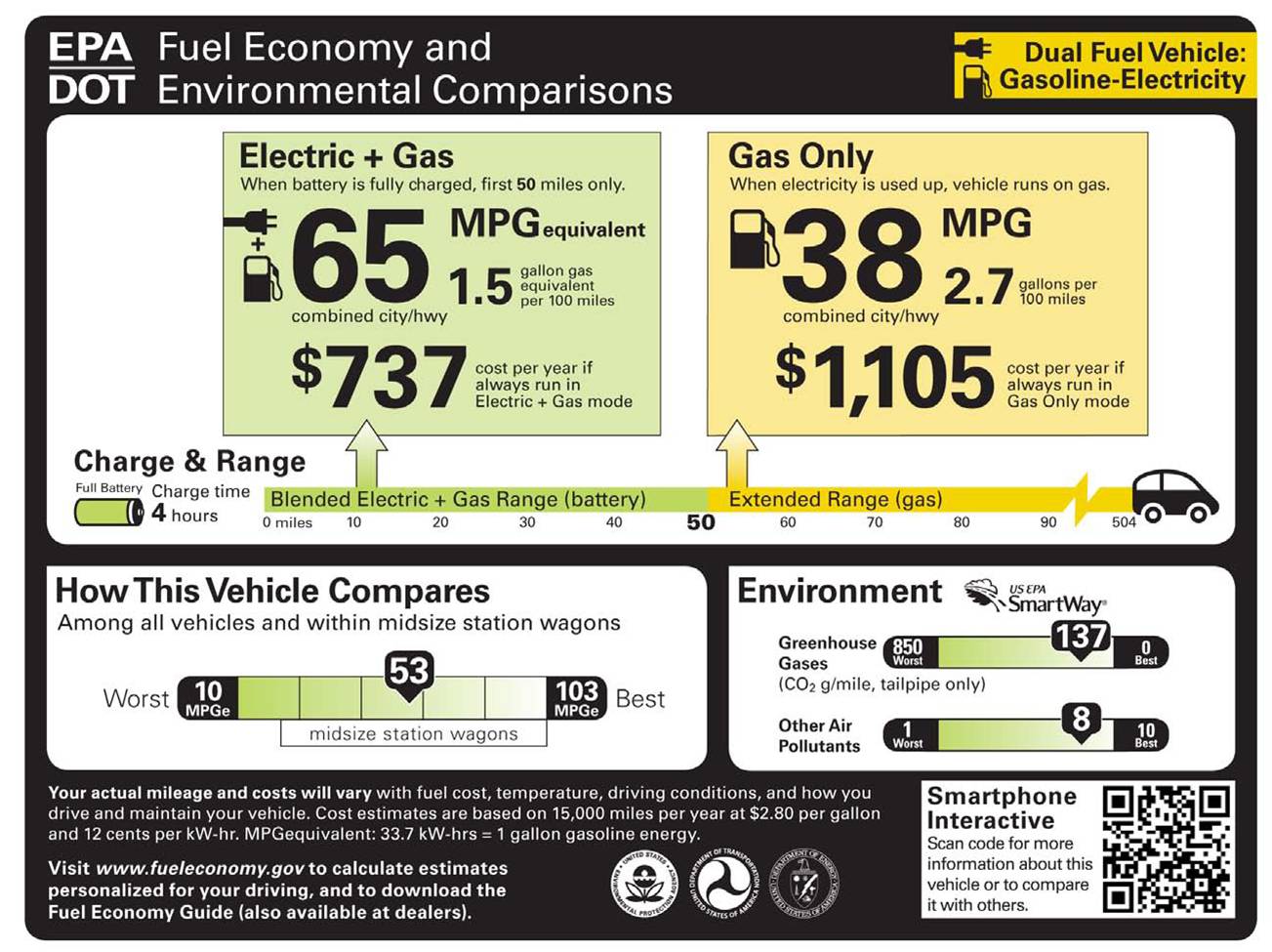
The EPA in conjunction with the Department of Transportation today showed two variations of upcoming fuel economy stickers. The stickers will be changing to accomodate electric and plug in vehicles. One of the options shown includes a school grading style system for the vehicle's overall "greeness", from A+ to D. You can't Fail according to the government. The other proposed labeling system looks a lot more like the current window stickers. The updated labels also show the fuel economy/energy consumption of electric vehicles and plugins in gallon equivalents. For example one of the EPA labels shows an electric vehicle getting 98 mpg equivalent. This means that this vehicle will travel 98 miles on the same amount of energy contained in one gallon of gas. The labels also split up plugin vehicles like the upcoming Chevy Volt into their elecric modes and gas. One label shows a proposed plug in vehicle achieving 65 mpg equivalent on electricity and getting 38 mpg on gasoline once the battery is drained and the gas engine kicks in.
While a letter grading system is perhaps unnecessary and makes for silly looking window sticker, the EPA did the right thing by utilizing the miles per gallon equivalents for the electric and plugin vehicles. This eliminates the unrealistic ratings for plugin hybrids promised by some eariler. This system also allows the consumer to compare the overall efficiency of an electric vehicle or a plugin hybrid to vehicles with conventional internal combustion engines.
You can let your voice be heard and tell the EPA which label it should use here.


While a letter grading system is perhaps unnecessary and makes for silly looking window sticker, the EPA did the right thing by utilizing the miles per gallon equivalents for the electric and plugin vehicles. This eliminates the unrealistic ratings for plugin hybrids promised by some eariler. This system also allows the consumer to compare the overall efficiency of an electric vehicle or a plugin hybrid to vehicles with conventional internal combustion engines.
You can let your voice be heard and tell the EPA which label it should use here.

Tuesday, August 11, 2009
Chevy Volt To Possibly Get 230 MPG
GM made a big announcement that its upcoming Chevy Volt could get an EPA city rating of 230 miles per gallon. Sounds amazing, doesn't it? What doesn't look to be as amazing is the fact that the 230 mpg figure results from some magical calculations. The Volt is a range-extended electric vehicle, once the battery is drained it turns on its internal combustion engine and uses gasoline. GM says that the Volt can travel 40 miles before the battery is drained. At this point calculating the fuel economy rating of the Volt becomes complicated. The 230 mpg figure is only possible if the Volt completes the EPA's fuel economy test solely on electric power and then completes the test again powered by the gasoline engine. In the end the Volt ends up using .22 of a gallon of gas to travel 51 miles, resulting in the 230 mpg figure. But this completely ignores the electrical energy used up. Like all things in life, it's not free either. And most likely comes with emissions as well. The GM press release also states that the Volt will use up 25 kilowatt-hours of electrical energy to travel 100 miles in the city. Thanks to this handy chart 25 kilowatt-hours contain the same amount of energy as 3/4 of a gallon of gas. This means that in pure electric mode the Volt would only travel 134 miles using the same amount of energy that's in a gallon of gas, thus cutting down the 230 mpg figure to 134. And since the Volt's battery is only good for 40 miles, the last 60 miles would be powered solely by gasoline. GM expects the Volt to achieve about 50 mpg when the battery runs out.
While the Volt is a fascinating concept that is poised to change how people commute daily, GM's 230 mpg quote looks to be powered by hype.

The breakdown of Volt's EPA test come from here.
While the Volt is a fascinating concept that is poised to change how people commute daily, GM's 230 mpg quote looks to be powered by hype.

The breakdown of Volt's EPA test come from here.
Thursday, July 23, 2009
The Dirtiest Cars for Sale Today
The current cars and trucks for sale in America are significantly cleaner than the vehicles sold in the past, emitting only fraction of the pollution of the old days. The vast majority of the models listed in the EPA Green Vehicle Guide have an EPA pollution score of at least 6. However, there are quite a few bad apples that don't fair nearly as well when it comes to pollution.
- The vast majority of "heavy duty" pickups and vans have EPA pollution score of 1, 2, or 3 out of 10 depending on configuration. (Ford F-250/350 and E-250/350 , Dodge Ram 2500/3500, Silverado 2500/3500 and Express 2500/3500, GMC Sierra 2500/3500 and Savana 2500/3500)
- The Dodge Avenger and Chrysler Sebring with the 2.7 V6 have a score of 3 in all states except California and Northeast.
- The Lexus SC 430 has a score of 3 in the same states.
- Toyota Scion xD has a score of 3 in the same states.
Subscribe to:
Posts (Atom)